Chamfered Edge: Complete Guide to Its Uses, Benefits, Types, and Applications
Precision Begins at the Edge
The smallest design details often have the greatest impact on the quality, safety, and performance of a product. One such detail is the chamfered edge, a simple yet highly effective feature found in everything from precision-engineered machine parts to modern furniture and architectural designs. While it may appear to be nothing more than a slanted cut along the edge of a material, a chamfer serves multiple important functions that improve durability, simplify assembly, enhance appearance, and reduce safety hazards.
Whether you’re a mechanical engineer, woodworker, manufacturer, DIY enthusiast, or simply curious about design terminology, understanding what a chamfered edge is and why it is used can help you appreciate the role it plays across countless industries. From aerospace and automotive manufacturing to home décor and construction, chamfered edges contribute to better product performance and a more refined finish.
In this comprehensive guide, we’ll explore everything you need to know about chamfered edges, including how they are created, why they matter, where they are commonly used, and how they compare to other edge treatments such as bevels and fillets.
What Is a Chamfered Edge?
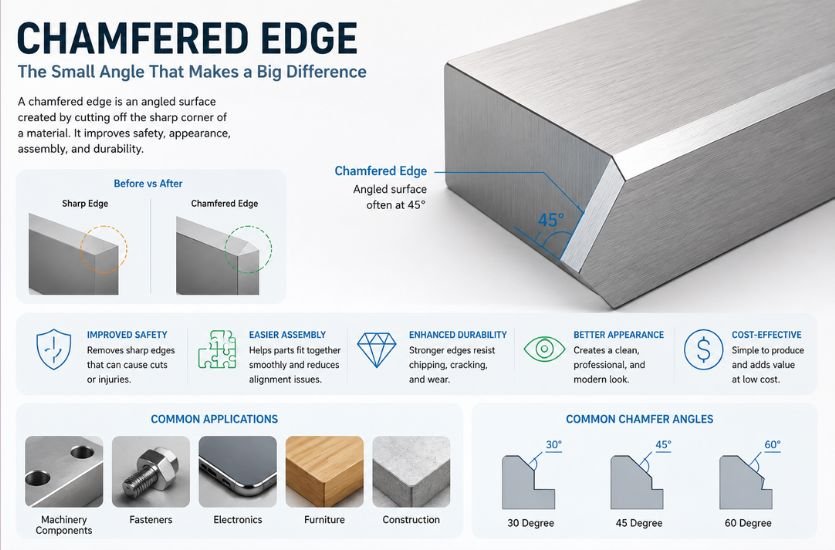
A chamfered edge is an angled surface created by cutting away the sharp corner where two flat surfaces meet. Instead of leaving a perfectly square 90-degree edge, manufacturers remove a small portion of the corner to form a flat, sloping face. This angled cut is commonly made at a 45-degree angle, although many other angles can be used depending on the specific design requirements.
Unlike rounded edges or curved transitions, a chamfer maintains a flat surface that provides both functional and aesthetic benefits. The size of a chamfer can range from a barely noticeable fraction of a millimeter on precision-engineered parts to large decorative chamfers used in architecture and furniture.
Chamfered edges are considered one of the most common finishing features in manufacturing because they improve usability without adding significant complexity to the production process.
How Does a Chamfered Edge Work?
A chamfer works by removing the sharp point where two surfaces intersect. Although this may seem like a minor modification, it changes the way the edge interacts with people, tools, and other components.
When two machine parts need to fit together, a sharp edge can catch or interfere during assembly. A chamfer creates a gradual lead-in that helps align components more easily. This reduces installation time while minimizing the chance of damaging the parts.
In products intended for everyday use, chamfered edges eliminate sharp corners that could otherwise scratch surfaces, tear packaging, or cause minor injuries during handling. The angled edge also distributes impacts differently, making corners less susceptible to chipping or deformation.
From an engineering standpoint, chamfers provide predictable geometry that can be consistently manufactured using standard machining processes. This consistency makes them ideal for high-volume production environments where precision and repeatability are essential.
Why Are Chamfered Edges So Important?
Although they occupy only a small portion of a product’s overall design, chamfered edges provide several important advantages that influence performance, safety, manufacturing efficiency, and visual appeal.
One of the primary reasons for using chamfers is safety. Sharp edges can easily cut skin or damage nearby materials during handling, transportation, or installation. By removing these sharp corners, manufacturers create products that are safer for workers, installers, and end users.
Chamfers also improve assembly efficiency. Components such as shafts, bearings, pins, bolts, and threaded fasteners often require precise alignment during installation. A chamfer acts as a guide that helps these components slide smoothly into place, reducing the likelihood of misalignment and assembly errors.
Another important reason is durability. Sharp corners are naturally weaker because they tend to concentrate impact forces at a single point. A chamfer distributes these forces across a wider surface, making edges less likely to chip or crack during normal use.
Visual appearance is another major consideration. Modern industrial design frequently incorporates chamfered edges because they create crisp, clean lines that give products a premium and professionally finished look. This design choice is especially common in electronics, furniture, luxury fixtures, and architectural elements.
The History of Chamfered Edges
Chamfered edges have been used for centuries in construction, stone masonry, and woodworking. Skilled craftsmen discovered that removing sharp corners not only improved the appearance of finished products but also reduced edge damage during transportation and installation.
In ancient architecture, stone columns, doorways, and decorative moldings often featured chamfered corners to create elegant transitions between surfaces. These angled cuts reflected light differently than square edges, adding depth and visual interest to buildings.
As industrial manufacturing evolved during the nineteenth and twentieth centuries, chamfers became standard practice in machining. Engineers recognized that angled edges simplified assembly and improved the reliability of mechanical systems. Today, virtually every industry uses chamfers in one form or another.
Advancements in CNC machining and automated manufacturing have further increased the precision of chamfered edges, allowing manufacturers to produce highly consistent parts with extremely tight tolerances.
Common Chamfer Angles
Although chamfers can be produced at almost any angle, several measurements are used far more frequently than others. The choice depends on the function of the component, manufacturing standards, and design specifications.
The 45-degree chamfer is by far the most common because it removes equal amounts of material from both adjoining surfaces. This symmetrical design offers an excellent balance between strength, appearance, and ease of manufacturing.
Thirty-degree chamfers are often selected when less material needs to be removed while still eliminating sharp corners. These are commonly found on lightweight components or decorative applications.
Sixty-degree chamfers are used in specialized engineering situations where a steeper lead-in angle provides improved alignment or better compatibility with mating components.
Some industries also use custom chamfer angles that are specifically engineered for unique products, aerospace applications, medical devices, or precision mechanical assemblies where even minor geometric differences can affect performance.
Materials That Can Be Chamfered
One of the reasons chamfering is so widely used is its compatibility with an enormous range of materials. Whether the material is soft, hard, metallic, or composite, manufacturers can usually produce accurate chamfered edges using appropriate machining or finishing techniques.
Metals such as steel, stainless steel, aluminum, brass, copper, and titanium are among the most commonly chamfered materials. These materials frequently appear in automotive, aerospace, industrial, and construction applications where precision is essential.
Wood is another popular material for chamfering. Furniture makers often use chamfered edges to create elegant tabletops, cabinets, shelves, and decorative trim. Besides improving aesthetics, chamfers help reduce splintering while making furniture more comfortable to handle.
Plastic products also benefit from chamfered edges. Injection-molded components often incorporate chamfers to improve assembly, reduce stress during manufacturing, and make finished products easier to handle.
Glass, acrylic, stone, concrete, ceramic, and engineered composites can likewise be chamfered to improve safety, enhance appearance, or prepare surfaces for installation.
Where Chamfered Edges Are Commonly Found
Once you begin recognizing chamfered edges, you’ll notice them almost everywhere. They appear in countless products used both at home and in industrial settings.
Mechanical parts frequently feature chamfers on shafts, gears, bearings, housings, fasteners, and precision-machined components. These angled edges help ensure smooth assembly while protecting delicate surfaces during installation.
Modern furniture often incorporates chamfered edges to create sleek, contemporary designs. Dining tables, desks, bookshelves, cabinets, and entertainment centers commonly use chamfers to soften their appearance without sacrificing clean geometric lines.
Architectural applications include concrete columns, staircases, decorative moldings, countertops, wall panels, and structural beams. Chamfered corners not only improve aesthetics but also reduce damage caused by everyday wear.
Consumer electronics also benefit from chamfered edges. Smartphones, laptops, tablets, monitors, and premium accessories frequently use subtle chamfers to create a refined appearance while improving comfort during handling.
Across these diverse applications, the underlying purpose remains the same: improve function, safety, durability, and design through a simple but highly effective modification.
Chamfer vs. Bevel: Understanding the Difference
The terms chamfer and bevel are often used interchangeably, but they are not always identical. Both involve creating an angled edge, yet their applications and design purposes can differ depending on the industry.
A chamfer specifically refers to the flat, angled surface that replaces a sharp corner where two surfaces meet. In engineering drawings and machining operations, chamfers are typically used to improve assembly, remove sharp edges, eliminate burrs, and enhance safety. The angle is frequently 45 degrees, making the modification symmetrical and easy to manufacture.
A bevel, on the other hand, is a broader term describing any angled edge that is not perpendicular to the adjoining surfaces. Beveled edges may extend across the full thickness of a material and are widely used in woodworking, glass manufacturing, welding preparation, and decorative architecture. While every chamfer can technically be considered a type of bevel, not every bevel qualifies as a chamfer.
For example, a glass tabletop may feature a wide decorative bevel around its perimeter, while a machined steel shaft often includes a small chamfer that helps guide the part during assembly. Understanding this distinction helps designers communicate manufacturing requirements more accurately.
Chamfer vs. Fillet
Another common comparison is between a chamfer and a fillet. Although both are used to modify sharp corners, they achieve this in entirely different ways.
A chamfer creates a straight, flat surface by cutting away the corner at an angle. A fillet, however, replaces the corner with a smooth, rounded curve. Each approach offers unique advantages depending on the application.
Chamfers are generally easier and less expensive to machine because they require simple linear cutting operations. This makes them highly suitable for mass production and precision engineering. They also provide excellent lead-in surfaces that simplify the assembly of mechanical components.
Fillets, on the other hand, distribute stress more evenly throughout a part because they eliminate sharp transitions. This makes rounded corners particularly valuable in components that experience repeated loading, vibration, or fatigue. Aerospace components, pressure vessels, and structural parts often use fillets to improve long-term durability.
The choice between a chamfer and a fillet ultimately depends on the product’s intended function. If ease of manufacturing and assembly are the primary goals, a chamfer is usually preferred. If reducing stress concentrations is more important, engineers may select a fillet instead.
Types of Chamfered Edges
Chamfers are available in several forms to accommodate different manufacturing processes and design objectives. Although the fundamental concept remains the same, the dimensions and angles vary depending on the application.
Equal-distance chamfers are the most common type. Material is removed equally from both adjoining surfaces, producing a symmetrical angled face. These chamfers are widely used in CNC machining, automotive manufacturing, and general engineering because they are simple to specify and manufacture.
Unequal chamfers remove different amounts of material from each surface. These are used when parts require specialized clearances or must mate with uniquely shaped components. Engineers often specify unequal chamfers in custom machinery and precision instruments.
Decorative chamfers are primarily intended to improve appearance rather than mechanical performance. Furniture manufacturers, interior designers, and architects frequently use larger decorative chamfers to create elegant shadows and highlight clean geometric lines.
Functional chamfers focus entirely on performance. These are commonly found on threaded fasteners, bearings, shafts, gears, and precision-machined components where assembly speed and reliability are essential.
How Chamfered Edges Are Manufactured
The process used to create a chamfer depends largely on the material being worked and the precision required. Modern manufacturing offers numerous techniques capable of producing accurate chamfered edges with exceptional consistency.
CNC milling is one of the most widely used methods. Computer-controlled milling machines use specialized chamfer cutters to remove material at precise angles while maintaining extremely tight tolerances. This method is ideal for producing complex metal components used in aerospace, automotive, and industrial machinery.
Turning operations performed on CNC lathes also produce chamfers, particularly on cylindrical components such as shafts, bushings, and threaded fasteners. During turning, the cutting tool creates the angled edge as part of the machining cycle, eliminating the need for secondary operations.
Grinding is commonly used when exceptionally smooth finishes or extremely accurate dimensions are required. Precision grinding machines produce chamfers on hardened steel components, cutting tools, bearings, and medical equipment where even microscopic inaccuracies can affect performance.
In woodworking, routers equipped with chamfer bits provide clean and consistent angled edges on furniture, cabinetry, moldings, and decorative panels. Hand planes and sanding tools may also be used by craftsmen to produce smaller or custom chamfers.
Laser cutting, waterjet cutting, and advanced robotic machining systems have further expanded the possibilities for producing chamfered edges on specialized materials with remarkable precision.
Chamfered Edges in CNC Machining
Chamfering is one of the final operations performed during CNC machining because it enhances both the functionality and appearance of finished parts. After the primary machining processes have shaped the component, chamfering removes any remaining burrs while preparing the part for assembly.
Precision-machined components frequently require extremely accurate chamfers because mating parts must fit together without excessive force or misalignment. Even a small chamfer can dramatically improve installation efficiency by guiding shafts into bearings, aligning threaded fasteners, and preventing edges from catching during assembly.
CNC machining also benefits from automated chamfering because the operation can be integrated directly into the manufacturing program. This minimizes production time while ensuring consistent results across thousands of identical components.
Manufacturers appreciate chamfering because it reduces manual finishing work, improves product quality, and decreases the likelihood of rejected parts caused by sharp edges or assembly difficulties.
Chamfered Edges in Woodworking
Woodworkers have long appreciated the value of chamfered edges for both practical and decorative reasons. Unlike square edges, which can feel bulky and are prone to splintering, chamfered edges create furniture that is both visually appealing and comfortable to use.
Dining tables often feature chamfered undersides that make the tabletop appear thinner and more elegant without sacrificing structural strength. Cabinets, shelving units, and drawers may also incorporate chamfers to create subtle shadow lines that enhance the overall design.
Handrails, stair treads, and wooden trim frequently include chamfered edges to reduce sharp corners while improving user comfort. These modifications also make finished products more resistant to minor impact damage during transportation and everyday use.
Modern minimalist furniture often relies on carefully proportioned chamfers to achieve a clean, sophisticated appearance. Rather than relying on ornate carvings or decorative moldings, designers use angled edges to create depth through light and shadow.
Chamfered Edges in Construction and Architecture
Chamfered edges play an important role in both structural and decorative construction projects. Concrete columns, beams, and wall panels frequently include chamfered corners to reduce chipping while producing cleaner architectural lines.
Stone countertops commonly feature chamfered edges because they provide a refined appearance while minimizing the risk of corner damage. The angled profile also improves comfort when users lean against countertops or work surfaces.
Architects often incorporate chamfered elements into building facades, door frames, window surrounds, and decorative trim to create visual interest through geometric simplicity. These subtle design choices contribute to the overall character of modern buildings while maintaining functional durability.
Even steel structural members may include chamfered edges after fabrication to improve safety during installation and eliminate potentially hazardous sharp corners on exposed surfaces.
Across manufacturing, woodworking, engineering, and architecture, the chamfered edge continues to demonstrate how a seemingly minor design feature can significantly improve safety, aesthetics, durability, and overall product performance.
Advantages of Using a Chamfered Edge
The widespread use of chamfered edges across industries is no coincidence. This simple design feature offers numerous advantages that improve both product functionality and manufacturing efficiency.
One of the greatest benefits is improved safety. Sharp corners can cause cuts, scratches, and accidental injuries during manufacturing, transportation, installation, or everyday use. Chamfering removes these hazardous edges, creating products that are safer to handle while reducing workplace accidents.
Chamfered edges also simplify assembly. Mechanical components such as bearings, shafts, gears, bolts, and threaded fasteners align much more easily when an angled lead-in is present. This reduces installation time, minimizes the chance of damaging mating parts, and increases production efficiency on assembly lines.
Another significant advantage is enhanced durability. Sharp corners are more vulnerable to chipping and deformation when subjected to impacts. By removing the fragile corner, a chamfer helps distribute impact forces more evenly, allowing products to withstand handling and transportation with less damage.
From a manufacturing perspective, chamfers are relatively inexpensive to produce. Most CNC machines, lathes, milling machines, and woodworking tools can create chamfered edges quickly without requiring complex programming or specialized equipment. This keeps production costs low while maintaining consistent quality.
Aesthetic improvement is another major reason manufacturers choose chamfered edges. The clean, angular appearance creates a refined, modern look that is widely appreciated in consumer electronics, luxury furniture, architectural features, and industrial equipment. Carefully designed chamfers also create attractive shadow lines that add depth and visual interest.
Potential Drawbacks of Chamfered Edges
Although chamfered edges offer numerous benefits, they are not the ideal solution for every application. Understanding their limitations helps engineers and designers choose the most appropriate edge treatment.
One limitation is that chamfering removes material from the workpiece. In situations where maximum contact area or structural thickness is required, excessive chamfering may reduce strength or alter the intended geometry of the part.
Chamfers also do not distribute stress as effectively as rounded fillets. Components subjected to continuous cyclic loading, vibration, or extreme fatigue often benefit more from curved transitions because smooth radii reduce stress concentrations more efficiently.
Another consideration is manufacturing precision. Although chamfers are relatively simple to machine, highly accurate chamfer dimensions are essential for components that require tight tolerances. Poorly machined chamfers can negatively affect part alignment or assembly quality.
In decorative applications, overly large chamfers may also alter the intended visual proportions of furniture or architectural elements. Designers must carefully balance functionality with aesthetics to achieve the desired appearance.
Industries That Rely on Chamfered Edges
Chamfered edges are used throughout modern industry because they improve product quality while supporting efficient manufacturing processes.
The automotive industry depends heavily on chamfers for engine components, transmission parts, suspension systems, fasteners, and precision-machined assemblies. These features simplify assembly while helping vehicles maintain long-term reliability.
Aerospace manufacturers use chamfered edges on structural components, landing gear systems, hydraulic fittings, and aircraft hardware where precision and consistency are essential. Every machined detail contributes to overall safety and performance.
Medical device manufacturers frequently incorporate chamfers into surgical instruments, implants, diagnostic equipment, and precision tools. Smooth, accurately machined edges improve usability while reducing the risk of accidental damage during delicate procedures.
Electronics manufacturers rely on chamfered edges to create premium-looking smartphones, laptops, tablets, computer accessories, and consumer devices. These subtle design features enhance both comfort and visual appeal.
Construction companies use chamfered concrete forms, steel beams, stone panels, and architectural trim to improve durability while creating clean, modern building designs.
Furniture manufacturers also embrace chamfered edges because they provide an elegant appearance while making products safer and more comfortable for everyday use.
How to Choose the Right Chamfer
Selecting the correct chamfer depends on the intended function of the finished product. Engineers begin by evaluating how the component will be assembled, what loads it will experience, and which manufacturing methods will be used.
For general mechanical components, a standard 45-degree chamfer often provides the best combination of ease of manufacturing and functional performance. This angle creates an effective lead-in while removing sharp edges efficiently.
Products designed primarily for appearance may use larger decorative chamfers to emphasize modern styling. Furniture makers, architects, and industrial designers often adjust chamfer dimensions to create distinctive visual effects through carefully controlled light reflections.
Precision engineering applications may require custom chamfer dimensions specified to within fractions of a millimeter. These specialized chamfers ensure perfect alignment between mating parts while meeting strict manufacturing tolerances.
Ultimately, the ideal chamfer balances functionality, appearance, manufacturability, and cost without compromising the overall design.
The Future of Chamfered Edge Design
Advancements in manufacturing technology continue to expand the possibilities for chamfered edge design. High-speed CNC machining, robotic automation, laser processing, and additive manufacturing allow manufacturers to produce increasingly complex components with remarkable precision.
Computer-aided design software enables engineers to simulate assembly, analyze stresses, and optimize chamfer dimensions before production even begins. This reduces manufacturing errors while shortening product development cycles.
As industries place greater emphasis on automation, sustainability, and precision engineering, chamfered edges will remain a fundamental design feature that supports both performance and manufacturability.
Emerging materials such as advanced composites and lightweight alloys will also continue to benefit from carefully engineered chamfers that improve durability while minimizing unnecessary material removal.
Frequently Asked Questions
What is a chamfered edge?
A chamfered edge is an angled surface created by removing the sharp corner where two surfaces meet. It improves safety, appearance, durability, and assembly efficiency across numerous applications.
What is the purpose of a chamfer?
The primary purpose of a chamfer is to eliminate sharp edges, simplify component assembly, reduce edge damage, improve product appearance, and increase user safety.
Is a chamfer the same as a bevel?
Not exactly. A chamfer is generally a specific type of bevel used to replace a sharp corner with a flat angled surface. A bevel is a broader term that can describe many different angled edge profiles.
Why are chamfers commonly used in machining?
Machined parts often include chamfers because they remove burrs, protect finished edges, guide components during assembly, and improve the overall quality of manufactured products.
What is the most common chamfer angle?
A 45-degree chamfer is the most widely used because it removes equal amounts of material from both adjoining surfaces while providing excellent functionality and ease of manufacturing.
Conclusion
Although a chamfered edge may appear to be a small design detail, its influence extends throughout modern engineering, manufacturing, construction, woodworking, and product design. By replacing sharp corners with carefully angled surfaces, chamfers improve safety, simplify assembly, increase durability, reduce manufacturing defects, and create products with a cleaner, more professional appearance.
From precision aerospace components and automotive parts to handcrafted furniture and contemporary architecture, chamfered edges continue to demonstrate that thoughtful engineering often lies in the smallest details. Their versatility, affordability, and practical benefits have made them one of the most widely used edge treatments in the world.
As manufacturing technologies continue to evolve, the importance of chamfered edges is unlikely to diminish. Instead, they will remain an essential element of high-quality design, helping manufacturers produce products that are stronger, safer, more attractive, and easier to use. Whether you’re designing a complex mechanical assembly or building a custom piece of furniture, understanding the role of a chamfered edge is an important step toward achieving precision and lasting quality.

Related Posts
Solar Surveillance Trailer: Complete Guide to Features, Benefits, Applications & Buying Tips

What Is an SSL Certificate Chain? How the Chain of Trust Secures HTTPS Websites