Turtle vs Tortoise: Key Differences, Similarities, Habitat, Diet, Lifespan and Amazing Facts
A slow-moving reptile carrying a protective shell is often called either a turtle or a tortoise, but these names are far from interchangeable. While they share a common ancestry and belong to the same reptile order, they have evolved to thrive in remarkably different environments. One is built for life in water, gliding effortlessly through oceans, rivers, and lakes, while the other is perfectly adapted for walking across dry landscapes with sturdy legs and a heavily domed shell. These unique adaptations make turtles and tortoises fascinating examples of how evolution shapes animals to survive in diverse habitats.
Many people assume the only difference between a turtle and a tortoise is where they live. In reality, the distinctions go much deeper. Their shells, limbs, diets, movement, lifespan, behavior, and even survival strategies differ significantly. Understanding these differences not only helps identify each animal correctly but also highlights the incredible diversity within the reptile world.
This guide explores the similarities and differences between turtles and tortoises, explains their habitats and physical characteristics, and answers common questions about these iconic shelled reptiles.
What Is a Turtle?
A turtle is a reptile belonging to the order Testudines, a group characterized by a hard protective shell that shields the body from predators and environmental dangers. Most turtles spend a significant portion of their lives in water, although the amount of time varies depending on the species. Some live almost entirely in freshwater lakes, rivers, ponds, and wetlands, while sea turtles spend nearly their entire lives in the ocean, returning to beaches only to lay eggs. Others are semi-aquatic, dividing their time between land and water.
Turtles are found on every continent except Antarctica. Their ability to adapt to a wide variety of aquatic environments has allowed hundreds of species to evolve, ranging from tiny musk turtles measuring only a few inches long to the enormous leatherback sea turtle, the largest living turtle species in the world.
The shell of a turtle is not simply an external covering. It is a living part of the skeleton, fused with the ribs and spine. This remarkable adaptation provides excellent protection while remaining lightweight enough for swimming. Most aquatic turtles also possess webbed feet or flippers that help them move efficiently through water.
Unlike many reptiles, turtles are known for their long lives. Depending on the species, they may live for several decades, with some sea turtles surviving more than 80 years in the wild.
What Is a Tortoise?
A tortoise is also a member of the order Testudines, but unlike most turtles, tortoises are entirely land-dwelling reptiles. They belong specifically to the family Testudinidae, which includes hundreds of species adapted to life in dry terrestrial environments. Tortoises can be found in deserts, grasslands, scrublands, tropical forests, and savannas across Africa, Asia, Europe, North and South America, and nearby islands.
Living exclusively on land has shaped nearly every aspect of a tortoise’s anatomy. Instead of webbed feet or flippers, tortoises have thick, muscular, elephant-like legs that support their heavy bodies and allow them to walk steadily over rough terrain. Their feet are equipped with strong claws used for digging burrows and searching for food.
One of the most recognizable features of a tortoise is its high, dome-shaped shell. This shell provides exceptional protection against predators by making it difficult for animals to bite or crush the tortoise. When threatened, many tortoises withdraw their head and limbs completely inside the shell until danger has passed.
Tortoises are famous for their extraordinary longevity. Many species routinely live well over a century, and giant tortoises have become symbols of longevity because some individuals have survived for more than 150 years under favorable conditions.
Are Tortoises Turtles?
One of the most common misconceptions is that turtles and tortoises are completely separate types of reptiles. Scientifically, this is not entirely accurate. All tortoises are turtles because every tortoise belongs to the reptile order Testudines. However, not every turtle is a tortoise.
The term “turtle” is often used as a broad category that includes aquatic turtles, freshwater turtles, sea turtles, and tortoises. The difference lies in classification. Tortoises represent one specialized family within the larger turtle group that has evolved specifically for life on land.
This distinction explains why turtles and tortoises share many similarities, including their shells, egg-laying reproduction, cold-blooded metabolism, and skeletal structure, while still displaying significant differences in appearance and behavior.
Turtle vs Tortoise: The Main Differences
Although turtles and tortoises share a common evolutionary history, millions of years of adaptation have produced animals with very different lifestyles.
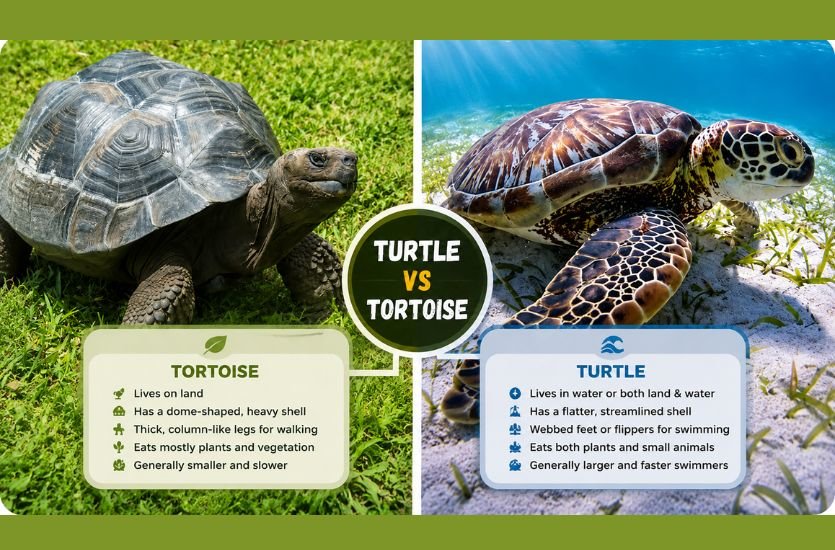
The most obvious distinction is habitat. Turtles are primarily aquatic or semi-aquatic, spending much of their lives in water. Sea turtles inhabit oceans across the globe, while freshwater turtles occupy rivers, lakes, marshes, and ponds. Tortoises, on the other hand, are terrestrial reptiles that rarely enter water except to drink or cool themselves.
Their shells also reflect their lifestyles. Turtle shells tend to be flatter, lighter, and more streamlined. This shape reduces water resistance, allowing turtles to swim efficiently. Tortoises possess heavier, taller, dome-shaped shells that offer superior protection against predators on land.
The limbs of these reptiles provide another easy way to distinguish them. Aquatic turtles usually have webbed feet that function like paddles, while sea turtles possess long flippers designed for powerful swimming across oceans. Tortoises have thick, sturdy legs resembling those of elephants. These strong limbs enable them to carry their heavy shells while walking across rocky or sandy landscapes.
Movement also differs considerably. Turtles are graceful swimmers capable of covering impressive distances underwater. Sea turtles migrate thousands of miles between feeding grounds and nesting beaches. Tortoises move much more slowly on land but possess remarkable endurance, allowing them to travel steadily in search of food and shelter.
Habitat Differences Between Turtles and Tortoises
Habitat plays one of the most important roles in distinguishing turtles from tortoises. Each has evolved physical characteristics perfectly suited to its environment.
Most turtles depend on water for survival. Freshwater turtles inhabit rivers, streams, ponds, marshes, swamps, and lakes where they feed, rest, and escape predators. Many species spend hours basking in the sun on rocks or fallen logs before returning to the water when disturbed.
Sea turtles are among the world’s most impressive marine travelers. They inhabit tropical and temperate oceans, crossing entire ocean basins during seasonal migrations. Despite spending almost their entire lives at sea, female sea turtles return to sandy beaches to lay eggs, often traveling back to the same beaches where they hatched decades earlier.
Semi-aquatic turtles occupy habitats that combine both water and land. They frequently move between these environments for feeding, basking, nesting, and avoiding predators.
Tortoises live in completely different environments. They thrive in deserts, dry grasslands, Mediterranean shrublands, tropical forests, and savannas where water is often limited. Their bodies are specially adapted to conserve moisture, allowing many species to survive in harsh climates where aquatic turtles could not.
Many tortoises dig burrows that provide protection from predators and extreme temperatures. These underground shelters help maintain stable humidity and cooler conditions during hot weather while also offering warmth during colder periods.
Shell Differences
The shell is one of the defining characteristics of both turtles and tortoises, but its design reveals how each animal has adapted to its surroundings.
A turtle’s shell is generally flatter, smoother, and more streamlined. This shape minimizes drag while swimming and allows the animal to move efficiently through water. The shell is also relatively lightweight, reducing the energy required for aquatic movement. Sea turtles, in particular, have highly streamlined shells that contribute to their exceptional swimming ability across vast oceans.
In contrast, a tortoise’s shell is tall, rounded, and heavily domed. This design makes it extremely difficult for predators to bite or crush the animal. The high dome also helps deflect attacks from predators attempting to grip the shell. Although heavier than a turtle’s shell, this extra weight is less of a disadvantage because tortoises spend their lives walking on land rather than swimming.
Another important feature is that both shells consist of two main sections. The upper portion is called the carapace, while the lower section protecting the underside is known as the plastron. These structures are made of bone covered by keratin scutes, the same material found in human fingernails and hair.
Unlike the shells of some other animals, a turtle or tortoise cannot leave its shell. It is permanently attached to the skeleton and forms an essential part of the reptile’s body, providing lifelong protection and structural support.
Differences in Feet and Movement
The feet and legs of turtles and tortoises reveal some of the most noticeable adaptations between these two reptiles. Since turtles spend much of their lives in water, their limbs are designed to help them move efficiently through aquatic environments. Freshwater turtles usually have webbed feet with strong claws that allow them to swim, climb onto rocks, and move around muddy shorelines. The webbing between their toes works like a natural paddle, helping them push through water with less effort.
Sea turtles have taken this adaptation even further. Instead of traditional feet, they have powerful flippers that allow them to travel through oceans. These flippers are highly specialized for swimming long distances, enabling sea turtles to migrate across thousands of kilometers between feeding areas and nesting beaches.
Tortoises have a completely different type of limb structure because they are built for walking on land. Their legs are thick, strong, and column-like, supporting the heavy weight of their bodies and shells. Their feet are usually round and sturdy, with short toes and strong claws. These features allow them to walk across rocky ground, dig shelters, and survive in challenging environments.
Unlike turtles, tortoises are not designed for swimming. Their heavy shells and dense bodies make them poor swimmers, and many tortoises can drown if they accidentally fall into deep water. Their strength comes from stability and endurance rather than speed.
Turtle vs Tortoise Diet Differences
The diets of turtles and tortoises are another major difference that reflects their environments and lifestyles. Turtles have a wide variety of diets depending on their species and habitat. Many freshwater turtles are omnivores, meaning they consume both plants and animals. They may eat aquatic plants, algae, insects, worms, small fish, snails, and other small aquatic creatures.
Sea turtles have more specialized diets. Green sea turtles, for example, mainly consume seagrass and algae as adults, while other species have different feeding habits. The leatherback sea turtle primarily eats jellyfish and other soft-bodied marine animals because of its unique digestive system.
Tortoises are mostly herbivores and depend heavily on plant-based foods. Their diet commonly includes grasses, leaves, flowers, fruits, vegetables, and desert plants. Some species living in dry regions consume cactus pads and other moisture-rich plants to help maintain hydration.
Because tortoises eat a high-fiber plant diet, their digestive systems are adapted to slowly break down tough vegetation. Their slow metabolism allows them to survive with limited food resources, which is especially important in environments where plants may be scarce.
Lifespan: Which Lives Longer, Turtle or Tortoise?
Both turtles and tortoises are famous for their impressive lifespans, but tortoises generally have the advantage when it comes to longevity. Their slow metabolism, protective shells, and land-based lifestyle contribute to their ability to live for many decades or even centuries.
Many tortoise species can easily reach 80 to 100 years old. Giant tortoises, such as the Galápagos giant tortoise and Aldabra giant tortoise, are among the longest-living animals on Earth. Some individuals have been recorded living beyond 150 years, making them living examples of biological endurance.
Turtles also have long lifespans, although the exact age depends on the species. Many freshwater turtles live between 20 and 50 years, while some larger species can survive much longer. Sea turtles may live for several decades, with some estimated to reach more than 80 years.
The long lives of these reptiles are connected to their slow growth, low-energy lifestyles, and strong natural defenses. However, reaching old age in the wild is becoming increasingly difficult because of habitat destruction, pollution, climate change, and human activity.
Behavior and Lifestyle Differences
Turtles and tortoises have developed different behaviors because of the environments they inhabit. Turtles are often more active swimmers and spend significant amounts of time exploring their surroundings in search of food. Aquatic turtles may dive underwater, hide among vegetation, and quickly escape predators by swimming away.
Many turtles also display interesting migration behaviors. Sea turtles are known for traveling across entire oceans and returning to specific beaches to reproduce. Scientists believe they use a combination of Earth’s magnetic field, ocean currents, and environmental signals to navigate.
Tortoises generally have a slower and more predictable lifestyle. They spend much of their time searching for plants, resting, basking in sunlight, and exploring their territory. Their slow movement helps them conserve energy, allowing them to survive in environments where food and water may be limited.
Many tortoises are excellent diggers. They create burrows to escape extreme heat, cold temperatures, and predators. These underground shelters provide a safe environment where they can rest and regulate their body temperature.
Reproduction Similarities Between Turtles and Tortoises
Despite their differences, turtles and tortoises share many similarities when it comes to reproduction. Both are egg-laying reptiles, meaning females leave their eggs in nests rather than giving birth to live young.
Female turtles usually come onto land to lay their eggs, even if they spend most of their lives in water. Sea turtles travel back to sandy beaches, dig nests using their rear flippers, and deposit dozens of eggs before returning to the ocean.
Tortoises also dig nests in soil or sand where they carefully bury their eggs. The temperature of the nest environment can influence the sex of hatchlings in many turtle and tortoise species, a phenomenon known as temperature-dependent sex determination.
After hatching, young turtles and tortoises are generally independent. They do not receive parental care and must immediately find food and avoid predators on their own. The survival rate of young hatchlings is often low because many are vulnerable to birds, mammals, and other threats.
Similarities Between Turtles and Tortoises
Although turtles and tortoises have many differences, they share several important characteristics that connect them. Both belong to the reptile group known as Testudines and have evolved a unique protective shell structure that distinguishes them from most other animals.
Both are cold-blooded creatures, meaning they depend on external sources of heat to regulate their body temperature. They often bask in sunlight to warm themselves and become more active. When temperatures drop, their activity levels decrease because their metabolism slows down.
Turtles and tortoises both have toothless mouths. Instead of teeth, they possess strong beak-like structures that help them cut and consume food. Their shells are also made of bone covered by keratin plates called scutes, providing a strong defensive barrier.
Another similarity is their remarkable ability to survive for long periods. Their slow metabolism allows them to use energy efficiently, helping them endure conditions where many other animals would struggle.
Conservation Challenges Facing Turtles and Tortoises
Despite surviving for millions of years, many turtle and tortoise species are currently facing serious threats. Habitat destruction is one of the biggest challenges. Wetland loss, ocean pollution, deforestation, and urban expansion have reduced the natural environments these reptiles depend on.
Sea turtles are especially affected by plastic pollution. Many mistake floating plastic waste for food, which can cause injury or death. They are also threatened by accidental capture in fishing nets, coastal development, and rising ocean temperatures that affect nesting areas.
Tortoises face different challenges, including illegal wildlife trade and habitat loss. Some species are captured and sold as exotic pets, while others struggle due to changes in their natural landscapes caused by agriculture and human development.
Conservation programs around the world are working to protect these reptiles through habitat preservation, breeding programs, legal protection, and public education. Protecting turtles and tortoises is important because they play valuable roles in their ecosystems, from maintaining healthy marine environments to controlling plant growth in terrestrial habitats.
Interesting Facts About Turtles and Tortoises
Turtles and tortoises are among the oldest surviving reptile groups on Earth. Their ancestors appeared more than 200 million years ago, meaning they existed alongside some dinosaur species.
The leatherback sea turtle is the largest living turtle, capable of reaching impressive sizes and traveling across entire oceans. Unlike most turtles, it has a flexible shell structure that helps it survive deep ocean conditions.
Giant tortoises are among the heaviest and longest-lived reptiles. Some can weigh hundreds of kilograms and survive for more than a century.
Tortoises can survive in harsh environments because of their ability to store water and conserve energy. Some desert species can go long periods without drinking because they obtain moisture from the plants they eat.
Turtles have incredible navigation abilities. Sea turtles can return to the same beaches where they were born, even after spending years traveling through open oceans.
Turtle vs Tortoise: Which One Is Better?
There is no simple answer to which animal is better because turtles and tortoises are adapted for completely different lifestyles. A turtle is better suited for aquatic environments, where its swimming ability, streamlined shell, and specialized limbs allow it to thrive. A tortoise is better adapted for life on land, where its strong legs, protective shell, and efficient metabolism help it survive.
For people considering them as pets, the choice depends on the owner’s ability to provide the correct environment. Turtles often require carefully maintained aquatic habitats with clean water, while tortoises need spacious land areas with proper temperature, lighting, and nutrition.
Both animals are fascinating examples of adaptation and survival. Their differences demonstrate how species can evolve unique characteristics to succeed in different environments.
Conclusion
The debate between turtle vs tortoise is not about deciding which reptile is superior. Instead, it reveals how two closely related animals can develop completely different abilities through evolution. Turtles are masters of aquatic life, using their streamlined bodies and swimming adaptations to explore rivers, lakes, and oceans. Tortoises are champions of land survival, relying on strength, endurance, and remarkable longevity.
While turtles and tortoises may look similar at first glance, their habitats, shells, feet, diets, behaviors, and lifestyles tell completely different stories. Understanding these differences helps us appreciate these ancient reptiles and recognize the importance of protecting them for future generations.
Whether swimming through the ocean or slowly crossing a desert landscape, both turtles and tortoises represent resilience, adaptation, and the incredible diversity of life on Earth.
