Chemistry Formulas: Complete Guide to Chemical Equations, Compounds, and Important Calculations
Chemistry is the science of transformation, where invisible particles combine, separate, and rearrange to create everything from the air we breathe to the medicines we use. Behind every chemical change lies a language of symbols and numbers known as chemistry formulas. These formulas allow scientists and students to describe substances, predict reactions, calculate quantities, and understand the behavior of matter at the atomic level.
From a simple formula like H₂O that represents water to complex equations used in industrial chemistry, formulas provide a universal way to communicate chemical information. Whether a student is preparing for school examinations, competitive tests, or studying advanced chemistry, understanding formulas is one of the most important steps toward mastering the subject.
Chemistry formulas are not just collections of letters and numbers. They represent the structure, composition, and relationships between atoms and molecules. By learning these formulas, students can understand how elements combine, how reactions occur, and how chemical calculations are performed in laboratories and industries.
Understanding Chemistry Formulas
A chemistry formula is a symbolic representation of a chemical substance or a mathematical relationship used in chemistry. Chemical symbols represent elements, while numbers written as subscripts show the quantity of atoms present in a molecule or compound.
For example, the formula of carbon dioxide is CO₂. The symbol C represents carbon, O represents oxygen, and the subscript ₂ indicates that one carbon atom is combined with two oxygen atoms. Similarly, the formula of ammonia is NH₃, meaning one nitrogen atom is bonded with three hydrogen atoms.
Chemistry formulas help identify compounds and explain their chemical composition. Without formulas, it would be extremely difficult to study millions of known chemical substances because scientists would need to describe every compound using lengthy written explanations.
Different Types of Chemistry Formulas
Chemistry formulas are divided into several categories depending on the information they provide. Each type plays an important role in understanding chemical substances.
A molecular formula shows the actual number of atoms of each element present in a molecule. It provides complete information about the composition of a compound. For example, the molecular formula of glucose is C₆H₁₂O₆, which means one glucose molecule contains six carbon atoms, twelve hydrogen atoms, and six oxygen atoms.
The molecular formula of water is H₂O, while the molecular formula of methane is CH₄. These formulas are commonly used in chemistry because they directly represent the composition of molecules.
An empirical formula represents the simplest whole-number ratio between atoms in a compound. It does not always show the actual number of atoms but gives the basic proportion between elements.
For example, hydrogen peroxide has the molecular formula H₂O₂. Its empirical formula is HO because the ratio of hydrogen to oxygen atoms can be simplified to one-to-one.
Empirical formulas are especially useful when determining the composition of unknown compounds through laboratory analysis.
A structural formula provides information about how atoms are connected within a molecule. It is particularly important in organic chemistry because compounds with the same molecular formula can have different structures and properties.
For example, ethanol and dimethyl ether both contain the same number of carbon, hydrogen, and oxygen atoms, but their structures are different, causing them to have different chemical properties.
Important Basic Chemical Compound Formulas
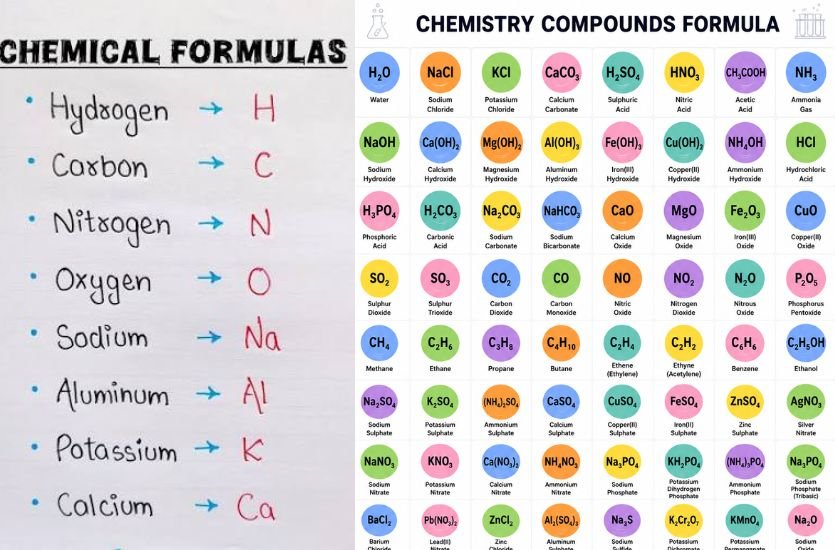
Many common substances used in daily life have chemical formulas that every chemistry student should know. Water, represented as H₂O, is one of the most familiar chemical compounds. It consists of two hydrogen atoms bonded with one oxygen atom.
Oxygen gas has the formula O₂ because oxygen naturally exists as molecules containing two oxygen atoms. Hydrogen gas is represented as H₂, while nitrogen gas is written as N₂.
Carbon dioxide, which is produced during respiration and combustion, has the formula CO₂. Carbon monoxide, a dangerous gas produced by incomplete combustion, has the formula CO.
Sodium chloride, commonly known as table salt, has the formula NaCl. It consists of sodium and chlorine ions arranged in a crystal structure.
Acids also have important chemical formulas. Hydrochloric acid is represented as HCl, sulfuric acid as H₂SO₄, and nitric acid as HNO₃. These acids are widely used in laboratories and industries.
Bases also have recognizable formulas. Sodium hydroxide has the formula NaOH, while calcium hydroxide is represented as Ca(OH)₂.
Other important compounds include calcium carbonate (CaCO₃), sodium bicarbonate or baking soda (NaHCO₃), ethanol (C₂H₅OH), and glucose (C₆H₁₂O₆).
Learning these basic formulas helps students understand chemical reactions and recognize substances quickly.
Mole Concept Formulas in Chemistry
The mole concept is one of the most important topics in chemistry because it connects the microscopic world of atoms and molecules with measurable quantities in laboratories.
A mole represents a specific number of particles. One mole of any substance contains 6.022 × 10²³ particles, known as Avogadro’s number.
The basic mole formula is:
Number of moles = Given mass / Molar mass
This formula allows chemists to convert the mass of a substance into the number of moles.
For example, if the molar mass of water is 18 grams per mole, then 18 grams of water contains one mole of water molecules.
Another important relationship is:
Number of particles = Number of moles × Avogadro’s number
This formula helps calculate the number of atoms, molecules, or ions present in a sample.
The mole concept is used extensively in chemical equations because reactions occur according to fixed ratios between molecules and atoms.
Chemistry Formulas for Chemical Equations
Chemical equations describe chemical reactions by showing reactants changing into products. A balanced chemical equation follows the law of conservation of mass, which states that atoms cannot be created or destroyed during a chemical reaction.
For example, the formation of water from hydrogen and oxygen is represented as:
2H₂ + O₂ → 2H₂O
This equation shows that two molecules of hydrogen react with one molecule of oxygen to produce two molecules of water.
Balancing chemical equations is essential because it ensures that the number of atoms on both sides of the equation remains equal.
Chemical equations are used in almost every branch of chemistry, including organic chemistry, inorganic chemistry, and industrial chemistry.
Concentration Formulas in Chemistry
Chemists often need to determine the amount of a substance present in a solution. Concentration formulas help measure how much solute is dissolved in a given amount of solvent.
Molarity is one of the most commonly used concentration measurements.
Molarity formula:
M = Moles of solute / Volume of solution in liters
Molarity tells the number of moles of solute present in one liter of solution.
Another important measurement is molality:
Molality = Moles of solute / Mass of solvent in kilograms
Unlike molarity, molality depends on the mass of solvent rather than the volume of solution.
Mole fraction is another concentration method used in chemistry:
Mole fraction = Number of moles of a component / Total number of moles
These formulas are important in solution chemistry, laboratory experiments, and industrial processes.
Gas Law Chemistry Formulas
Gases behave differently from solids and liquids because their particles move freely. Scientists developed gas laws to explain the relationship between pressure, volume, temperature, and the amount of gas.
PV=nRT
P=241(0.082057)(298)=1.019atm
P
atm
P
V
L
V
n
mol
n
T
K
T
Boyle’s Law explains the relationship between pressure and volume. According to Boyle’s Law, when temperature remains constant, pressure and volume are inversely proportional.
The formula is:
P₁V₁ = P₂V₂
Charles’s Law explains how gas volume changes with temperature. When pressure remains constant, the volume of a gas increases as temperature increases.
The formula is:
V₁/T₁ = V₂/T₂
The ideal gas equation combines pressure, volume, temperature, and number of moles into a single relationship:
PV = nRT
This equation is widely used to calculate gas properties in chemistry and physics.
Atomic Structure Chemistry Formulas
Atoms are the fundamental building blocks of matter, and understanding their structure is one of the first steps in learning chemistry. Atomic structure formulas help scientists understand the behavior of electrons, energy levels, and particles inside atoms.
An atom consists of three main particles: protons, neutrons, and electrons. Protons carry a positive charge, electrons carry a negative charge, and neutrons have no charge.
The atomic number formula is:
Atomic Number (Z) = Number of Protons
The atomic number identifies an element because every element has a unique number of protons.
The mass number formula is:
Mass Number (A) = Number of Protons + Number of Neutrons
This formula helps determine the total number of particles present inside an atom’s nucleus.
The relationship between these values can be written as:
Number of Neutrons = Mass Number − Atomic Number
These formulas are important for understanding isotopes, nuclear chemistry, and the arrangement of elements in the periodic table.
Quantum Chemistry Formulas
Quantum chemistry explains the behavior of electrons at the atomic level. Scientists use mathematical formulas to describe electron energy and movement.
The energy of an electron in an atom can be calculated using the Bohr model formula:
E = -2.18 × 10⁻¹⁸ / n² Joules
Here, “n” represents the principal quantum number or energy level of the electron.
Another important formula is the de Broglie equation:
λ = h/mv
This equation explains the wave nature of particles. It shows that moving particles, including electrons, have associated wavelengths.
Where:
λ = wavelength
h = Planck’s constant
m = mass of particle
v = velocity of particle
Quantum formulas help explain why atoms have specific structures and why elements show different chemical properties.
Chemical Bonding Formulas
Chemical bonding explains how atoms combine to form molecules and compounds. Atoms form bonds because they become more stable by gaining, losing, or sharing electrons.
Ionic compounds form when electrons are transferred between atoms. For example, sodium chloride forms when sodium loses one electron and chlorine gains one electron.
Na → Na⁺ + e⁻
Cl + e⁻ → Cl⁻
The resulting compound is:
Na⁺ + Cl⁻ → NaCl
Covalent bonds occur when atoms share electrons. Examples include hydrogen gas (H₂), oxygen gas (O₂), and water (H₂O).
Understanding chemical formulas helps predict the type of bonding and properties of substances.
Acids, Bases, and pH Formulas
Acids and bases are important areas of chemistry because they explain the behavior of many substances in solutions.
The pH scale measures how acidic or basic a solution is.
The pH formula is:
pH = -log[H⁺]
Where [H⁺] represents the concentration of hydrogen ions.
A solution with a pH below 7 is acidic, a pH of 7 is neutral, and a pH above 7 is basic.
The pOH formula is:
pOH = -log[OH⁻]
The relationship between pH and pOH is:
pH + pOH = 14
These formulas are used in laboratories, environmental chemistry, medicine, and industrial processes.
Thermodynamics Chemistry Formulas
Thermodynamics deals with energy changes during chemical reactions. It explains whether reactions release energy or require energy.
The heat energy formula is:
q = mcΔT
Where:
q = heat energy
m = mass
c = specific heat capacity
ΔT = temperature change
This formula helps calculate the amount of heat absorbed or released by a substance.
Enthalpy change is another important thermodynamic concept.
The formula is:
ΔH = H(products) − H(reactants)
A negative value of ΔH indicates an exothermic reaction, meaning heat is released. A positive value indicates an endothermic reaction, meaning heat is absorbed.
Another important formula is Gibbs free energy:
ΔG = ΔH − TΔS
Gibbs free energy helps determine whether a chemical reaction can occur naturally.
If ΔG is negative, the reaction is generally spontaneous. If ΔG is positive, the reaction requires additional energy.
Chemical Equilibrium Formulas
Chemical equilibrium occurs when the forward and reverse reactions happen at the same rate. At equilibrium, the concentrations of reactants and products remain constant.
The equilibrium constant formula is:
Kc = Concentration of products / Concentration of reactants
A large value of Kc indicates that products are favored, while a small value indicates that reactants are favored.
Equilibrium formulas are widely used in industrial chemistry, especially in processes like ammonia production.
Chemical Kinetics Formulas
Chemical kinetics studies the speed of chemical reactions and factors affecting reaction rates.
The rate of reaction formula is:
Rate = Change in concentration / Change in time
The Arrhenius equation explains the effect of temperature on reaction speed:
k = Ae⁻ᴱᵃ/ᴿᵀ
Where:
k = reaction rate constant
A = frequency factor
Ea = activation energy
R = gas constant
T = temperature
This formula helps scientists understand why increasing temperature usually increases reaction speed.
Electrochemistry Chemistry Formulas
Electrochemistry studies the relationship between chemical reactions and electricity. It is used in batteries, electroplating, and industrial processes.
The electrical charge formula is:
Q = It
Where:
Q = electric charge
I = current
t = time
Faraday’s law of electrolysis is:
m = ZIt
Where:
m = mass deposited
Z = electrochemical equivalent
I = current
t = time
The Nernst equation is another important electrochemical formula:
E = E° − (RT/nF) lnQ
It calculates electrode potential under different conditions.
Organic Chemistry Formulas
Organic chemistry focuses on carbon-containing compounds. Carbon has the unique ability to form long chains and complex structures, creating millions of organic compounds.
The general formula of alkanes is:
CₙH₂ₙ₊₂
Examples include:
Methane: CH₄
Ethane: C₂H₆
Propane: C₃H₈
Butane: C₄H₁₀
The general formula of alkenes is:
CₙH₂ₙ
Examples:
Ethene: C₂H₄
Propene: C₃H₆
The general formula of alkynes is:
CₙH₂ₙ₋₂
Example:
Ethyne: C₂H₂
Other important organic compounds include:
Benzene: C₆H₆
Ethanol: C₂H₅OH
Acetic acid: CH₃COOH
Glucose: C₆H₁₂O₆
Organic chemistry formulas are essential for understanding fuels, plastics, medicines, and biological molecules.
Common Chemistry Formulas Used in Daily Life
Many substances people use every day are based on chemical formulas.
Table salt is sodium chloride (NaCl), which is used in cooking and food preservation.
Baking soda is sodium bicarbonate (NaHCO₃), commonly used in baking and cleaning.
Vinegar contains acetic acid (CH₃COOH), which gives it its sour taste.
Sugar contains glucose and other carbohydrates with formulas such as C₆H₁₂O₆.
Carbon dioxide (CO₂) is important in photosynthesis and is also released during burning fuels.
Understanding these formulas helps people recognize the chemistry behind everyday materials.
Importance of Chemistry Formulas in Education and Science
Chemistry formulas are essential tools for students and researchers because they simplify complex chemical information. Instead of describing substances with long explanations, formulas provide a short and accurate representation.
Students use formulas to solve numerical problems, balance equations, and understand chemical reactions. In higher education, formulas become even more important because they are used in pharmaceutical research, environmental studies, material science, and industrial chemistry.
Scientists rely on formulas to design new materials, develop medicines, produce energy solutions, and study biological processes.
Tips to Memorize Chemistry Formulas
Learning chemistry formulas requires understanding rather than simple memorization. Students should first understand what each symbol represents and how elements combine.
Creating formula charts, practicing chemical equations regularly, and connecting formulas with real-life examples can make learning easier.
For example, remembering that water is H₂O becomes simpler when students understand that water molecules contain two hydrogen atoms bonded with one oxygen atom.
Regular revision and solving chemistry problems also improve formula retention.
Frequently Asked Questions About Chemistry Formulas
What are chemistry formulas?
Chemistry formulas are symbolic representations that show the elements present in a substance and the relationships between atoms or molecules.
Why are chemistry formulas important?
Chemistry formulas help identify compounds, calculate chemical quantities, understand reactions, and perform scientific calculations.
What is the most common chemistry formula?
One of the most commonly known chemistry formulas is H₂O, which represents water.
How can students learn chemistry formulas easily?
Students can learn formulas by understanding concepts, practicing regularly, creating revision notes, and applying formulas to problems.
Are chemistry formulas used outside classrooms?
Yes, chemistry formulas are used in medicine, manufacturing, environmental science, agriculture, and many industrial fields.
Conclusion
Chemistry formulas are the foundation of understanding chemical science. They provide a simple language that explains how atoms combine, how substances react, and how energy changes during chemical processes. From basic compounds like water and carbon dioxide to advanced equations used in thermodynamics and electrochemistry, formulas connect the microscopic world of atoms with real-world applications.
Mastering chemistry formulas allows students to solve problems confidently and develop a deeper understanding of how matter behaves. Whether used in classrooms, laboratories, or industries, these formulas continue to play a vital role in discovering new technologies and improving human life.