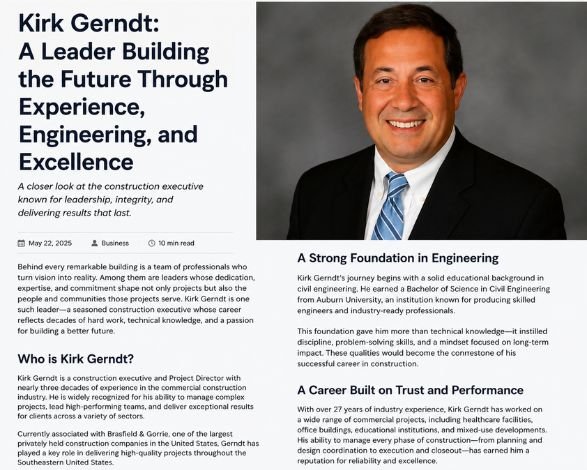
Kirk Gerndt: Leadership, Engineering Excellence, and a Lasting Impact on the Construction Industry
Every skyline tells a story of vision, precision, and determination. Behind towering office buildings, healthcare facilities, educational campuses, and commercial developments are professionals whose expertise transforms architectural concepts into lasting structures. Among the names associated with leadership in commercial construction, Kirk Gerndt has earned recognition for his experience in project management, engineering knowledge, and commitment to delivering complex construction projects with efficiency and quality.
Also Read: Nadeshda Ponce: Biography, Career, Background, and Growing Public Interest
Throughout a career spanning nearly three decades, Kirk Gerndt has built a reputation as a construction professional who understands every stage of project development, from initial planning to final completion. His work reflects the combination of technical expertise, strategic thinking, and collaborative leadership that modern construction demands. While he maintains a relatively low public profile compared to executives in highly visible industries, his professional contributions have attracted attention across construction-focused publications and industry discussions.
This article explores Kirk Gerndt’s professional background, engineering expertise, leadership philosophy, project management approach, and the qualities that have contributed to his standing within the commercial construction sector.
Early Educational Foundation
A successful construction career begins with a strong understanding of engineering principles, mathematics, design, and problem-solving. Reports published across multiple industry and profile websites indicate that Kirk Gerndt earned a Bachelor of Science degree in Civil Engineering from Auburn University, an institution well known for producing engineering professionals who contribute to infrastructure and commercial development throughout the United States.
An engineering education provides much more than technical calculations. Students develop analytical thinking, structural understanding, project planning skills, and the ability to evaluate complex challenges from multiple perspectives. These abilities become essential when managing projects that involve millions of dollars in investment, hundreds of workers, strict regulatory requirements, and demanding construction schedules.
Civil engineering also emphasizes responsibility. Every project affects communities, businesses, and the people who will ultimately occupy completed buildings. This educational foundation appears to have influenced Gerndt’s professional approach throughout his construction career.
Building a Career in Commercial Construction
Commercial construction differs significantly from residential building. Projects are larger, budgets are higher, regulations are more extensive, and coordination among contractors, architects, engineers, suppliers, and clients becomes increasingly complex.
Kirk Gerndt established his career by working on projects that required careful planning, strong communication, and disciplined execution. Over the years, he developed expertise in managing every phase of construction while balancing quality, safety, scheduling, and financial performance.
Construction professionals often spend years progressing through increasingly responsible positions. Early career experiences typically involve field engineering, project coordination, scheduling, estimating, or site supervision. As expertise grows, responsibilities expand into project management, operational leadership, client communication, and executive decision-making.
Industry profiles consistently describe Gerndt as someone who advanced through these professional stages by combining technical knowledge with practical leadership skills.
Leadership at Brasfield & Gorrie
One of the most frequently associated aspects of Kirk Gerndt’s professional career is his work with Brasfield & Gorrie, one of the largest privately held construction companies in the United States. The company has developed a reputation for delivering commercial, healthcare, institutional, industrial, and mixed-use construction projects across the Southeast and other regions.
Working within a major construction organization requires more than engineering expertise. Large-scale developments involve multidisciplinary teams consisting of architects, structural engineers, mechanical engineers, electrical specialists, subcontractors, consultants, owners, and regulatory agencies.
Project leaders must coordinate all of these stakeholders while ensuring that schedules remain on track, budgets stay under control, and quality expectations are consistently met.
Reports describing Gerndt’s role suggest extensive involvement in project leadership, where collaboration and communication play an essential part in successful project delivery.
The Importance of Project Management
Project management serves as the backbone of every successful construction project. Even the most innovative architectural designs can experience delays or budget overruns without effective coordination.
Professionals like Kirk Gerndt are often recognized for their ability to oversee numerous moving parts simultaneously. Construction schedules involve procurement timelines, permitting requirements, subcontractor coordination, inspections, safety compliance, material deliveries, and workforce management.
Unexpected challenges frequently arise during construction. Weather conditions, supply chain disruptions, design modifications, labor availability, and unforeseen site conditions can all influence project outcomes.
Experienced project managers anticipate these risks before they become major obstacles. Through planning, communication, and continuous monitoring, they minimize disruptions while maintaining project momentum.
Gerndt’s career reflects the importance of structured planning combined with practical flexibility, qualities that remain essential for delivering large commercial developments successfully.
Engineering Expertise in Practice
Engineering extends beyond calculations performed during project design. Throughout construction, engineering knowledge influences countless decisions involving structural integrity, material selection, construction sequencing, and quality assurance.
Professionals with engineering backgrounds often possess an advantage because they understand both technical design requirements and real-world construction practices.
This combination allows project leaders to communicate effectively with architects and engineers while also addressing the practical concerns raised by contractors working in the field.
Engineering expertise also contributes to better decision-making when unexpected challenges emerge. Rather than relying solely on administrative processes, technically trained leaders can evaluate engineering implications before selecting the most effective solution.
This balance between technical accuracy and operational efficiency appears to be a recurring characteristic associated with Gerndt’s professional reputation.
Delivering Complex Commercial Projects
Commercial construction encompasses a wide variety of building types, each presenting unique challenges.
Office buildings require sophisticated mechanical and electrical systems that support modern workplaces. Healthcare facilities demand precise compliance with medical regulations and specialized infrastructure. Educational campuses involve extensive coordination to minimize disruption while serving students and faculty. Mixed-use developments combine residential, retail, and commercial spaces into integrated environments.
Each project introduces different technical requirements, stakeholder expectations, and operational priorities.
Managing these developments successfully requires detailed scheduling, disciplined financial oversight, and consistent communication among every participant involved in construction.
Industry discussions surrounding Kirk Gerndt frequently emphasize his experience with projects that require careful organization and long-term strategic planning.
Commitment to Safety
Safety remains one of the defining priorities within the construction industry.
Construction sites present numerous hazards involving heavy equipment, elevated work areas, electrical systems, excavation activities, and material handling operations. Maintaining safe working conditions protects employees while supporting efficient project execution.
Strong safety cultures extend beyond regulatory compliance. They encourage continuous training, hazard identification, proactive planning, and accountability throughout every level of an organization.
Experienced project leaders understand that safety contributes directly to productivity, workforce morale, and project success.
Professionals recognized for effective leadership often prioritize safety discussions during planning meetings, daily operations, and ongoing project reviews.
Maintaining these standards helps create work environments where employees can perform confidently while reducing unnecessary risks.
Financial Management and Cost Control
Construction projects operate within carefully established budgets that account for labor, materials, equipment, subcontractors, permits, insurance, and contingency planning.
Financial management requires continuous monitoring rather than occasional review.
Project leaders must evaluate changing market conditions, supplier pricing, labor costs, and schedule impacts throughout construction.
Small adjustments made early can prevent significant financial challenges later in the project lifecycle.
Successful cost management depends upon accurate forecasting, transparent reporting, and disciplined decision-making.
Construction professionals who consistently deliver projects within budget often earn long-term trust from clients because financial reliability represents one of the industry’s most valued characteristics.
Communication as a Leadership Strength
Construction projects bring together individuals representing numerous professional disciplines.
Architects focus on design intent.
Engineers prioritize structural performance.
Owners emphasize investment value.
Contractors manage field execution.
Inspectors oversee regulatory compliance.
Suppliers coordinate materials and equipment.
Each group contributes unique expertise while pursuing shared project goals.
Effective communication connects these diverse perspectives.
Project leaders must explain technical information clearly, facilitate productive meetings, resolve disagreements constructively, and maintain alignment throughout the project schedule.
Leadership often depends less on giving instructions and more on building consensus among experienced professionals.
This collaborative style has become increasingly important as commercial construction projects continue growing in complexity.
Mentorship and Professional Development
Construction knowledge develops through experience as much as formal education.
Many respected industry professionals contribute by mentoring younger engineers, project managers, and field supervisors.
Experienced leaders share practical insights that cannot always be found in textbooks.
Lessons involving scheduling, negotiation, stakeholder management, conflict resolution, and leadership become invaluable resources for professionals entering the industry.
Organizations benefit significantly when experienced project leaders invest time in developing future talent.
Mentorship strengthens company culture while supporting long-term organizational success.
Industry profiles discussing Gerndt often reference his willingness to guide teams and encourage professional growth among colleagues.
Adapting to Industry Changes
Construction has evolved dramatically during the past several decades.
Digital modeling, building information modeling (BIM), drones, laser scanning, cloud-based collaboration platforms, and advanced project management software have transformed traditional workflows.
Sustainability has also become a central priority.
Owners increasingly seek energy-efficient buildings that reduce environmental impact while improving long-term operational performance.
Construction leaders must continually adapt to changing technologies, updated building codes, evolving client expectations, and new regulatory standards.
Professionals who remain committed to continuous learning position themselves to lead increasingly sophisticated projects.
Adapting successfully requires openness to innovation while preserving the practical knowledge gained through years of field experience.
Building Long-Term Client Relationships
Construction projects often extend over many months or even several years.
Throughout that time, clients evaluate not only technical performance but also communication, transparency, responsiveness, and reliability.
Strong client relationships develop through consistent delivery rather than isolated achievements.
Project leaders who demonstrate honesty during challenges often build greater trust than those who only communicate positive developments.
Reliable communication, realistic scheduling, and proactive problem-solving contribute to lasting professional partnerships.
Organizations frequently secure repeat business because clients value dependable leadership as much as technical capability.
Reputation Within the Industry
Professional reputation develops gradually through years of consistent performance.
Construction executives earn respect by delivering quality work, supporting their teams, maintaining ethical standards, and successfully managing complex projects.
Unlike highly public industries where recognition often comes through media exposure, construction professionals typically build reputations through completed projects, client satisfaction, peer recommendations, and long-term professional relationships.
This steady approach reflects the nature of commercial construction itself, where lasting results often matter more than public attention.
The discussions surrounding Kirk Gerndt generally focus on professional competence, leadership experience, and project delivery rather than personal publicity.
Lessons from a Construction Career
The professional journey associated with Kirk Gerndt illustrates several principles that remain relevant for aspiring engineers, project managers, and construction leaders.
Technical education provides a valuable foundation, but leadership requires continuous learning beyond formal academic training.
Successful projects depend upon collaboration rather than individual achievement.
Careful planning reduces uncertainty while improving execution.
Financial discipline and quality control remain equally important throughout construction.
Adaptability enables professionals to respond effectively to changing technologies and evolving client expectations.
Above all, integrity and professionalism continue to serve as the foundation for long-term success within the construction industry.
Conclusion
Kirk Gerndt represents the type of construction professional whose influence is measured not through public visibility but through completed projects, effective leadership, and decades of industry experience. His reported background in civil engineering, extensive involvement in commercial construction, and leadership responsibilities reflect the qualities required to manage today’s increasingly sophisticated building projects.
From engineering fundamentals and project management to client collaboration and operational excellence, his career demonstrates how technical expertise and leadership can work together to deliver successful outcomes. As commercial construction continues evolving through technological innovation, sustainability initiatives, and increasingly complex developments, experienced professionals who combine engineering knowledge with practical management skills remain essential to the industry’s future.
Although publicly available information about Kirk Gerndt is relatively limited and much of it originates from secondary profile websites rather than detailed official biographies, the consistent themes surrounding his career emphasize dedication, professionalism, and a commitment to delivering high-quality construction projects. These qualities continue to define effective leadership within one of the world’s most demanding and impactful industries.