Pilfer Word Game: The Complete Guide to Rules, Strategies, Gameplay, and Tips for Winning
Words become weapons the moment the countdown begins. Every new letter that appears creates an opportunity, every second matters, and every word you’ve built can disappear in an instant if another player spots a better combination. That thrilling blend of speed, vocabulary, and strategy is exactly what makes the Pilfer Word Game stand out among modern online word games.
Unlike traditional word games that rely on turn-based gameplay, Pilfer keeps every player engaged from start to finish. Instead of patiently waiting for your next move, you’re constantly scanning the board, spotting new word opportunities, protecting your existing words, and looking for chances to steal from your opponents. The result is a competitive experience that feels fast, unpredictable, and highly rewarding.
Whether you’re discovering Pilfer for the first time or looking to sharpen your skills, understanding the game’s mechanics is the first step toward becoming a stronger player. This comprehensive guide explains how the Pilfer Word Game works, why it has become increasingly popular among word game enthusiasts, and what strategies can help you win more matches.
What Is the Pilfer Word Game?
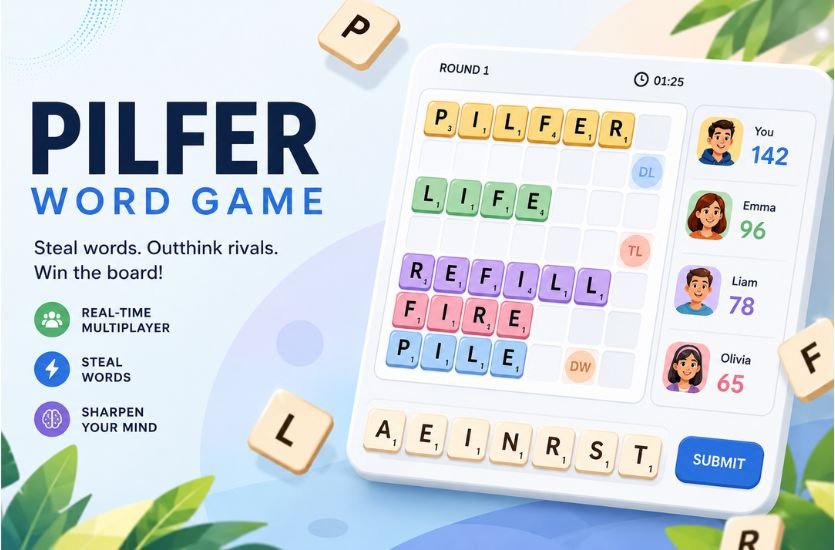
Pilfer is an online multiplayer word game that challenges players to create words from a shared pool of letters while competing against others in real time. Instead of taking turns, every participant plays simultaneously, making the gameplay much faster than classic board games or traditional digital word puzzles.
The feature that truly separates Pilfer from other vocabulary games is its stealing mechanic. Players are not limited to creating brand-new words. They can also transform an opponent’s existing word into a longer or entirely different valid word by rearranging the letters and adding newly revealed letters. This creates a constantly changing game board where no word remains safe for long.
Because every player has access to the same letters, success depends on quick thinking, an extensive vocabulary, and the ability to recognize patterns before anyone else does.
How the Pilfer Word Game Works
The gameplay begins with an empty board and a sequence of letters that gradually appear throughout the match. As each new letter is revealed, players immediately begin searching for possible words.
Whenever a player identifies a valid word using the available letters, they can claim it. That word then becomes part of their collection and contributes toward their score or overall letter control, depending on the version of the game being played.
The excitement grows as additional letters appear. Those new letters often make it possible to expand existing words into entirely different ones. Players continuously monitor both their own words and those of their opponents because any eligible word may become vulnerable to being stolen.
For example, a simple four-letter word might suddenly become the foundation for a much longer word after several additional letters appear. A player who notices the opportunity first can steal the word, instantly changing the balance of the game.
This constant evolution means the game rarely slows down. Every newly revealed letter creates fresh possibilities, forcing players to think ahead while reacting quickly to changing circumstances.
The Rules of Pilfer
Although different platforms may feature slight variations, the core rules remain consistent.
Players use only the letters currently available on the board. Words must meet the minimum length requirement established by the game version, which is commonly four letters. Every submitted word must be recognized by the game’s dictionary.
Stealing another player’s word requires more than simply making it plural. The transformation must create a genuinely different word by rearranging the existing letters and incorporating one or more newly available letters. This rule prevents repetitive gameplay while encouraging creative thinking and vocabulary expansion.
Throughout the match, additional letters continue appearing until the full letter pool has been revealed. Once every letter has been introduced, the game enters its final countdown, during which players have one last opportunity to create or steal words before time expires.
When the timer reaches zero, the winner is determined based on the scoring system used in that particular version of Pilfer.
Why Pilfer Is Different from Traditional Word Games
Many people compare Pilfer to games like Scrabble, Boggle, or Wordle because they all involve vocabulary. However, Pilfer delivers an entirely different style of gameplay.
Traditional word games usually emphasize careful planning, deliberate moves, and turn-based strategy. Players often spend time evaluating multiple possibilities before making a single decision.
Pilfer replaces that slow pace with continuous action. Every second introduces new opportunities, and hesitation often means losing valuable words to faster opponents.
Another major difference is player interaction. In many word games, each participant focuses primarily on their own board or personal score. Pilfer encourages constant observation of every player’s progress because another person’s word might become your next scoring opportunity.
This competitive interaction keeps every match exciting from beginning to end.
The Importance of Word Stealing
The stealing mechanic is the defining feature of the Pilfer Word Game.
Instead of viewing opponents as separate competitors working on independent puzzles, players must constantly analyze everyone’s words. Every claimed word becomes a potential target if a longer or more valuable alternative becomes possible.
Stealing requires more than luck. Successful players quickly recognize hidden combinations that others overlook. They mentally rearrange letters while anticipating future possibilities created by incoming letters.
This aspect transforms Pilfer into much more than a spelling challenge. It becomes an exercise in pattern recognition, strategic planning, and rapid decision-making.
Players who master stealing often outperform those who focus solely on creating new words.
Skills You Develop While Playing Pilfer
One reason Pilfer has attracted a dedicated audience is that it exercises multiple cognitive skills simultaneously.
Vocabulary naturally improves through repeated exposure to unfamiliar words and letter combinations. Frequent players gradually recognize longer words, uncommon suffixes, and useful prefixes that can dramatically expand existing words.
Spelling accuracy also improves because players repeatedly construct valid words under time pressure.
Mental flexibility becomes increasingly important as players constantly shift between offensive and defensive thinking. One moment they are protecting their own collection of words, and the next they are searching for opportunities to steal from others.
Pattern recognition develops naturally because experienced players begin identifying common letter arrangements almost instantly.
Typing speed also becomes a valuable advantage since faster submissions often determine who successfully claims or steals a word first.
Together, these skills make Pilfer both entertaining and mentally stimulating.
Strategies That Can Improve Your Performance
Winning consistently requires much more than possessing a large vocabulary.
Strong players rarely focus on the longest words immediately. Instead, they often build shorter words early to establish control before expanding them later as additional letters appear.
Keeping an eye on opponents is equally important. Watching only your own words means missing valuable opportunities to steal from others.
Experienced players also anticipate future possibilities rather than reacting only to the current board. They mentally test multiple extensions for each existing word, preparing themselves before the necessary letters even appear.
Learning common prefixes and suffixes can provide a major advantage. Recognizing endings like “-ing,” “-tion,” “-ment,” “-able,” or prefixes such as “re-,” “un-,” and “dis-” allows players to identify potential upgrades much faster.
Calmness under pressure is another valuable skill. Many beginners panic during the final countdown and overlook obvious words. Experienced competitors remain focused, systematically scanning the board instead of rushing random guesses.
Consistent practice gradually improves reaction time, vocabulary recall, and strategic awareness.
Common Mistakes Beginners Make
Every new player experiences a learning curve.
One common mistake is concentrating exclusively on creating new words while ignoring opportunities to steal existing ones. Since stealing often produces larger gains, overlooking those opportunities limits overall performance.
Another mistake involves building words that are easy to transform. Certain short words contain letter combinations that can quickly evolve into much larger words, making them attractive targets for opponents.
Some beginners also stop searching once they have claimed several words. In reality, Pilfer rewards continuous attention because every newly revealed letter changes the available possibilities.
Rushing submissions without carefully checking spelling is another frequent error. Invalid words waste precious seconds and may cause players to miss legitimate opportunities.
Finally, many players underestimate the importance of observation. Paying close attention to the entire game board often reveals valuable steals that would otherwise remain hidden.
Why Pilfer Appeals to So Many Players
Pilfer successfully combines several qualities that modern gamers appreciate.
Matches are relatively short, making it easy to enjoy a quick game during breaks or spare moments throughout the day.
The competitive nature encourages improvement without requiring lengthy tutorials or complicated rules.
Every match feels different because changing letter combinations create unique gameplay experiences. Even experienced players encounter fresh challenges that prevent the game from becoming repetitive.
The game’s educational value also attracts students, teachers, and lifelong learners. Expanding vocabulary while competing against others provides an enjoyable alternative to traditional learning exercises.
Families often appreciate that players of different ages can compete together, with success depending on vocabulary knowledge, observation, and quick thinking rather than physical skill.
Comparing Pilfer with Other Popular Word Games
Pilfer occupies a unique position within the world of word games.
Wordle emphasizes solving a single puzzle through logical deduction. Each player works independently without interacting with others.
Scrabble focuses on carefully placing letter tiles to maximize scoring opportunities over multiple turns. Strategy develops gradually throughout the game.
Boggle challenges players to identify as many words as possible within a fixed grid before time expires.
Pilfer combines elements from several of these games while introducing real-time multiplayer competition and word stealing. Rather than solving isolated puzzles, players actively compete over shared resources in an environment where every decision affects everyone else.
This constant interaction creates excitement that many traditional word games cannot replicate.
Is Pilfer Good for Learning Vocabulary?
Pilfer serves as an excellent educational tool because learning happens naturally during gameplay.
Players repeatedly encounter unfamiliar words while observing opponents. Curiosity often leads them to explore meanings, spellings, and alternative word forms after matches conclude.
The game’s emphasis on prefixes, suffixes, and word extensions helps players recognize relationships between words instead of memorizing isolated vocabulary.
Repeated exposure reinforces spelling patterns and improves recognition speed over time.
Teachers and parents looking for engaging educational activities may find Pilfer particularly appealing because it combines entertainment with meaningful language practice.
Rather than feeling like homework, vocabulary development becomes an enjoyable consequence of regular play.
Tips for Becoming a Better Pilfer Player
Improvement comes through consistent practice and thoughtful observation.
Playing regularly strengthens vocabulary recall while increasing familiarity with common letter combinations. Reading books, articles, and diverse written material also expands the range of words that players can recognize during matches.
Studying common prefixes and suffixes makes it easier to identify opportunities for expansion and stealing.
Watching experienced players can reveal strategies that beginners may overlook, particularly regarding efficient board scanning and anticipating future letter combinations.
Remaining patient during difficult matches is equally important. Even skilled players occasionally lose words to faster opponents. Treating each game as a learning opportunity helps maintain steady improvement over time.
The Future of Real-Time Word Games
Games like Pilfer demonstrate how traditional vocabulary challenges can evolve into highly interactive multiplayer experiences.
Modern players increasingly seek games that combine education, entertainment, and competition without requiring lengthy commitments. Pilfer successfully meets all three expectations by offering short, engaging matches that reward knowledge, speed, and creativity.
As online multiplayer gaming continues expanding across different age groups, real-time word games are likely to attract even larger audiences. Their accessibility makes them appealing to casual players, while their strategic depth provides lasting challenges for experienced competitors.
Pilfer represents an exciting direction for digital word games by proving that language-based gameplay can remain fresh, competitive, and endlessly replayable.
Final Thoughts
The Pilfer Word Game offers far more than a simple vocabulary challenge. Its combination of real-time competition, evolving letter pools, and strategic word stealing creates a unique experience that rewards both intelligence and quick reactions. Every match demands concentration, adaptability, and creative thinking, ensuring that no two games ever unfold in exactly the same way.
Whether your goal is to improve your vocabulary, sharpen your spelling skills, enjoy friendly competition, or simply experience a refreshing alternative to traditional word games, Pilfer delivers an engaging experience that keeps players coming back for more. With regular practice, expanding word knowledge, and a deeper understanding of the game’s strategic elements, anyone can improve their performance and enjoy the thrill of turning ordinary letters into winning opportunities.
